Chapter 2 of the Budget is all about the question that has shaped UK economic life for the last three years: how do living standards start rising again after the shock of high inflation?
The government sets the scene with a blunt admission. Real household disposable income fell in the last Parliament, the first time that’s happened since records began. That decline has now reversed, and the OBR expects living standards to rise by nearly 3% over this Parliament. But inflation has eroded so much ground that the recovery still feels fragile.
This chapter sets out how the government plans to push prices down, stabilise household budgets and modernise the tax and public spending system so the improvement actually lasts.
Inflation and Living Standards: Where Things Stand Now
Although the headline inflation rate has been falling, it hasn’t fallen far enough to translate into real relief for households. Food prices rose by more than 25% between 2022 and 2024, and repeated shifts in the energy price cap kept bills volatile throughout 2024 and 2025. So even with inflation now at 3.6%, people are still living with the compound effect of several years of sharp price increases. Prices have not come down, they have simply stopped rising as quickly.
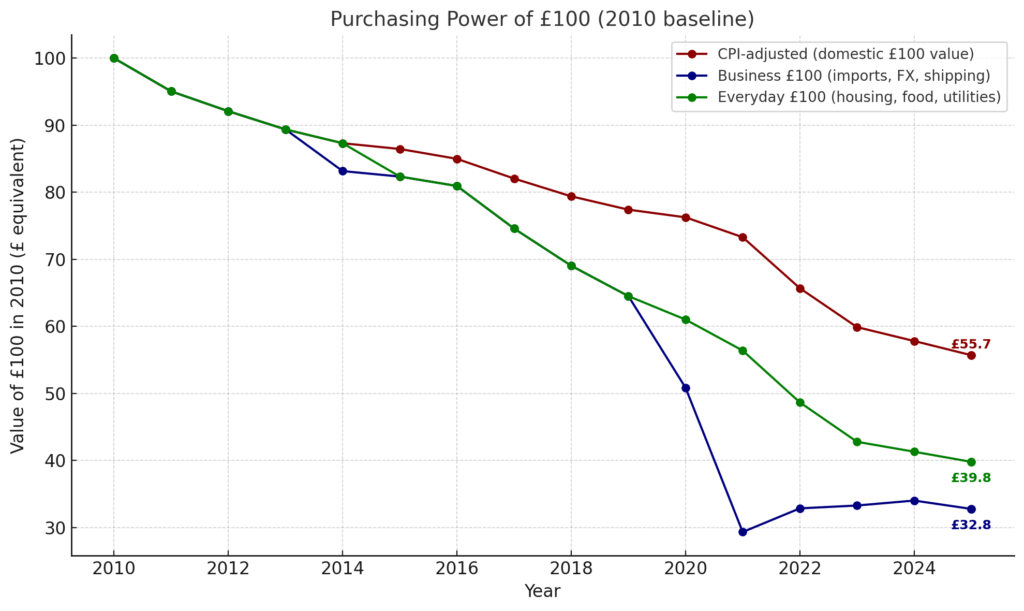
This distinction is often lost in public commentary. A lower inflation rate only slows the pace of price rises; it does not unwind the increases already baked in. In our recent analysis of inflation, we modelled this using ONS data and showed the purchasing power of £100 falling steadily every year since 2010. £100 in 2010 now buys just £55.70 on CPI terms, and far less for households with higher exposure to housing, food and utilities. The annual inflation curve may fall, but the price level never returns to where it was.
Chapter 2 of the Budget focuses heavily on easing ongoing pressures, particularly energy, transport, childcare, rents and essential costs, and the OBR estimates that the measures announced here will reduce CPI by around 0.4 percentage points next year. Outside of crisis interventions, that is the largest single-year reduction they have ever attributed to Government policy.
My view, however, is that while lowering inflation is important, it does not restore affordability on its own. To materially improve living standards from here, either tax reform that leaves working households with more disposable income, or a structural reduction in essential living costs, will be required.
Energy Bills: A Structural Change, Not a One-Off Payment
The biggest intervention in this chapter is the plan to remove about £150 from the average household energy bill from April 2026. Instead of funding certain decarbonisation schemes through bills, the government will shift the cost onto the Exchequer. This includes taking on most of the cost of the Renewables Obligation and ending the Energy Company Obligation altogether.
The Government argues that this is not a short-term voucher or rebate. In their view, it represents a structural change to how policy costs are funded, which they say makes it a more durable reform. They also state that it should have a direct effect on measured inflation, because these policy costs sit inside the energy price cap itself.
On top of that, six million households will receive the £150 Warm Home Discount this winter, and the Warm Homes Plan receives another £1.5 billion to improve energy efficiency.
Transport Costs: Aiming for Predictability
Transport makes up around 14% of household spending, so changes here have the potential to have real weight if done correctly.
The Government’s position is that regulated rail fares in England will be frozen for a full year from March 2026, the first time this has happened in three decades. However, the policy does not reduce the underlying cost of rail travel. For example, Network Rail access charges typically make up a large share of operating costs (often cited in the 40–60% range depending on the route and operator), yet there is no indication of any plan to reform or reduce these charges. As a result, the freeze holds prices steady, but does not address the structural cost drivers that keep fares high.
The £3 bus cap, originally a temporary cost-of-living measure, is now extended through to March 2027. Fuel duty stays 5p lower until August 2026, and the government has cancelled the inflation rise for 2026–27.
From Spring 2026, drivers will also see the Fuel Finder scheme come online, making it easier to compare prices locally and adding a bit more competition into what people actually pay at the pump.
Food, Housing and Everyday Costs
Food inflation is still higher than normal, even though headline rates have come down. The government highlights a new agri-food agreement with the EU that should make trading fresh food simpler and cheaper, potentially saving up to £200 per shipment for importers, and a new regulatory “gateway” to prevent overlapping rules from pushing prices higher again.
Housing pressures are also addressed, particularly in the private rented sector. With rents still elevated, the Renters’ Rights Act will give tenants the ability to challenge rent rises designed to force them out, and Section 21 evictions will be abolished.
Other cost-of-living areas covered include water bills, where long-term reforms are coming later this year, and new work with the CMA on dentistry, veterinary services, telecoms and the live events ticket resale market.
Support for Families, Children and Pensioners
A major part of Chapter 2 is the shift in support towards families with children. The most significant change is the removal of the two-child limit in Universal Credit, which the government says will lift around 450,000 children out of poverty initially, rising to 550,000 when combined with free school meals expansion.
Free breakfast clubs will extend to another 2,000 schools, and eligibility for free school meals will widen to all pupils in households receiving Universal Credit. There are also measures to cut uniform costs and increase childcare support for larger families.
Universal Credit’s Standard Allowance rises by over 6% in April 2026. Pensioners continue to be protected under the Triple Lock, with the State Pension rising by 4.8% that year. The National Living Wage will rise to £12.71 per hour from April 2026.
The distributional analysis makes the government’s intent clear: lower-income households see the largest gains as a share of income, and tax increases fall mainly on the highest-income groups.
Tax Reform: A Shift Toward Wealth and Asset Income
Instead of raising headline income tax, NICs or VAT rates, the Government leans heavily on threshold freezes and a set of reforms it frames as increases on wealth, property and asset-derived income.
Income tax and employee/self-employed NIC thresholds will remain frozen until April 2031, as will inheritance tax thresholds. The student loan repayment threshold for Plan 2 borrowers is fixed for a further three years from April 2027. These measures do not touch wealth at all, they simply increase the tax paid by workers through fiscal drag, gradually reducing the real value of take-home pay each year.
From 2026 and 2027, tax on dividends, savings income and property income will rise. New property-income bands are being introduced, and dividend and savings rates will each increase by 2%. There is also a new High Value Council Tax Surcharge from April 2028 for homes worth more than £2 million.
Other “wealth-related” reforms include adjustments to agricultural and business property relief, reducing Employee Ownership Trust CGT relief from 100% to 50%, and capping the NIC-free portion of salary-sacrifice pension contributions at £2,000 from 2029. But these two latter measures do not primarily affect passive wealth:
the salary-sacrifice cap exclusively affects employees, many of whom are already under pressure from frozen thresholds
the EOT CGT change affects SME owners planning succession, not individuals with large investment portfolios or passive asset income
This is where the contradiction becomes clear. The Government presents these changes as a shift toward taxing wealth, but many of the new burdens fall instead on working households and mid-income employees, while the major passive wealth advantages, rental income portfolios, large capital gains outside EOTs, investment vehicles, and inherited wealth structures, remain largely intact.
The result is a package that raises substantial revenue from work and from SME succession, but has a more limited impact on the forms of unearned wealth that contribute most to long-term inequality. It is difficult to reconcile this with the stated aim of increasing disposable income for working families.
Motoring and Electric Vehicles: Preparing for the Future
The Budget openly acknowledges the long-term problem: as electric vehicles replace petrol and diesel cars, fuel duty revenue collapses. To address this, the government will introduce a new mileage-based Electric Vehicle Excise Duty (eVED) from April 2028.
The average EV driver would pay roughly £240 per year. Plug-in hybrids will pay a reduced rate, and other vehicle types are out of scope at this stage. Importantly, the system will not involve tracking location or requiring in-car devices.
To balance this, the government is putting substantial funding into the EV transition: extending the Electric Car Grant with another £1.3 billion, raising the threshold for the EV Expensive Car Supplement, funding EV infrastructure and offering business rates relief for chargepoints and EV-only forecourts.
Other Tax and Sector Changes
A number of sector-specific measures appear throughout the chapter: changes to VAT treatment for private hire vehicle operators, the introduction of vaping liquid duty, inflation-linked alcohol duty rises from 2026, and a significant increase in the Remote Gaming Duty to 40%.
Corporation Tax stays at 25%, but writing down allowances on main-rate assets fall from 18% to 14%. To offset that, a new 40% First-Year Allowance will come into effect from January 2026.
Motoring and Electric Vehicles: Preparing for the Future
The final part of Chapter 2 focuses on how the government intends to fund public services sustainably while pushing for better value.
Capital investment remains high, with major commitments to transport, defence, NHS technology, new Neighbourhood Health Centres and social infrastructure. But there is a strong parallel emphasis on efficiency: reducing bureaucracy, cutting back-office costs, reducing agency spend in the NHS, tightening benefit administration and recovering more from fraud and error.
The government will also review public sector assets, expand disposal programmes and introduce a £1 billion asset efficiency target. Departments will undergo ongoing value-for-money reviews ahead of the next Spending Review in 2027.
Conclusion: A Budget That Raises More from Work Than Wealth
Taken together, the measures in Chapter 2 indicate a Budget that increases the effective tax burden on working households, employees, SME owners and agri-businesses, while leaving most established passive-wealth structures broadly unchanged.
Threshold freezes, student-loan threshold freezes, benefit tightening and the new salary-sacrifice cap all reduce net income for employees over time. Reforms to business and agricultural property relief also introduce new constraints for owners whose wealth is tied to actively managed enterprises rather than financial assets.
The dividend tax rise, a 2% increase across all bands, will fall primarily on SME directors who remunerate themselves through dividends. The very wealthiest individuals, whose investment returns are often channelled through offshore entities, holding companies or long-established asset vehicles, will see comparatively limited exposure to this change.
Similarly, the reduction in Employee Ownership Trust CGT relief and the cap on NIC-free pension salary sacrifice affect entrepreneurs and employees instead of the passive-wealth class whose returns derive predominantly from investment portfolios, property portfolios and other financial assets.
In practice, the Budget raises proportionally more from labour income and SME-level entrepreneurship than from unearned or passive wealth. Although the narrative positions these reforms as a shift toward taxing wealth, most conventional high-net-worth wealth structures remain largely untouched.
The headline message is that these measures will improve living standards. The practical effect is a repricing of tax liabilities toward employees, SME owners and operational businesses, rather than toward passive capital.