
Small and medium-sized businesses (SMEs) are the backbone of the UK economy. They represent more than 99% of all businesses, employ over half of the private-sector workforce, and generate a substantial share of national output. Yet despite their importance, SMEs have not been given the level of financial access necessary to grow to their full potential. Instead, many remain constrained by a funding system that was simply not designed with their needs, pace, or operating reality in mind.
This is reflected starkly in the data. The outstanding stock of UK SME loans today is around 14% lower than it was in 2015, signalling a decade of underinvestment in the very businesses that drive local growth, jobs, and innovation. At a time when the UK needs higher productivity and stronger regional development, the long-term stagnation in SME lending represents a structural brake on economic performance.
Yet the potential is clear. When SMEs do gain access to the right finance, the economic impact is immediate and significant. UK analysis shows that targeted SME funding supports billions of pounds in economic value and sustains tens of thousands of jobs each year. Behind these numbers are business owners investing in equipment, hiring new staff, opening new locations, securing larger contracts, and strengthening local supply chains, these are quite clearly, the hidden champions of the UK economy.
Most importantly, recent research directly quantifies what has long been understood qualitatively: access to finance is closely linked to measurable business success. Through analysis of thousands of UK business current accounts, the data shows that receiving external finance is associated with a 19% average increase in monthly inflows within twelve months. This is not theoretical modelling, it is demonstrated economic behaviour.
In other words: when SMEs are given the financing they need, they create tangible revenue growth.
The UK’s SME Finance Problem Isn’t Access, It’s Awareness
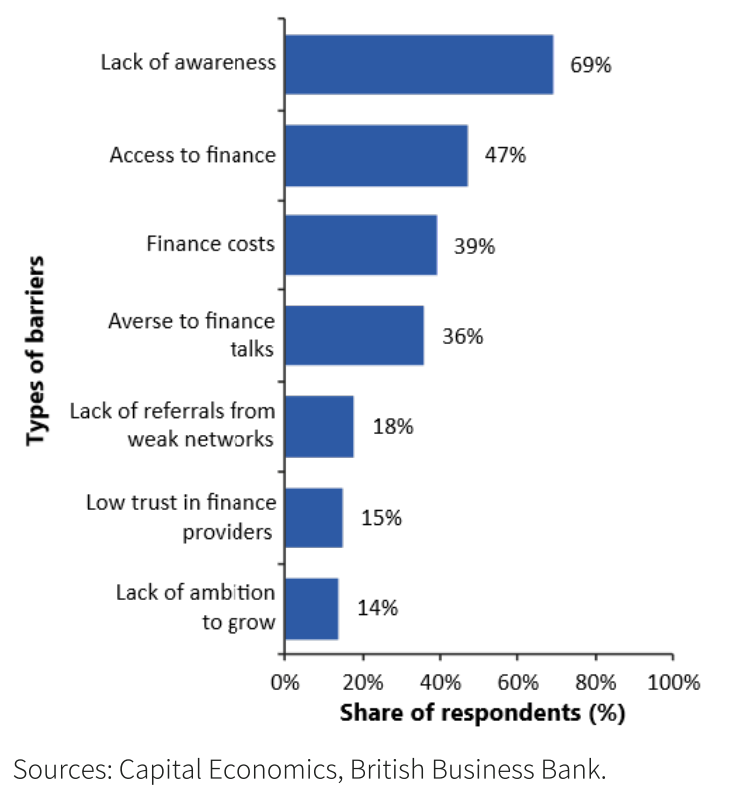
According to the British Business Bank and Capital Economics, 69% of SMEs identify lack of awareness as their main barrier to securing finance, making it by far the most significant obstacle.
By comparison, 47% say that access to finance itself is difficult, while 39% point to finance costs, and 36% admit they are generally averse to having conversations about finance at all.
A further 18% report that weak referral networks limit their ability to find suitable funding, and only 15% express low trust in finance providers, meaning structural distrust is relatively rare.
Taken together, these findings reveal a clear paradox: the UK now has more SME finance providers, more specialised products, and faster approval pathways than at any point in the last decade, yet SMEs are less equipped than ever to navigate the system or identify the right solution for their needs.
This explains a pattern we see daily:
Businesses aren’t being rejected because they cannot be funded, they put in the wrong application, to the wrong lender, using the wrong structure, at the wrong time.
As our pevious article “9000 Products, 900 Lenders: 2 in 3 SMEs Still Approach the Wrong Solution” already established:
Most SME declines are self-inflicted through mis-matched applications, not borrower weakness.
This directly aligns with the national data.
Awareness is the bottleneck, not the lending market.
When SMEs Do Get Finance, Turnover Rises by 19% on Average
SMEs that secure external finance see an average 19% increase in their monthly inflows within 7–12 months.
This uplift is based on:
8,100 anonymised SME bank accounts
Regression-controlled modelling
A comparison between firms receiving loans and firms not receiving loans
A second cross-check on a separate sample of 3,262 SMEs with similar baseline characteristics
The effect is not concentrated in distressed firms.
It is not temporary.
It is not limited to high-growth sectors.
It is systemic.
Sector example: Construction (42% uplift)
Construction SMEs exhibit the strongest uplift at 42%, a powerful signal that finance accelerates output and contract capture in labour-agile industries.
Implication for the UK economy
The UK does not lack entrepreneurial ambition.
It lacks a mechanism to convert ambition into output.
Finance is that mechanism, and the data finally proves it.
Why Finance Creates Growth (Not Just Cashflow Relief)
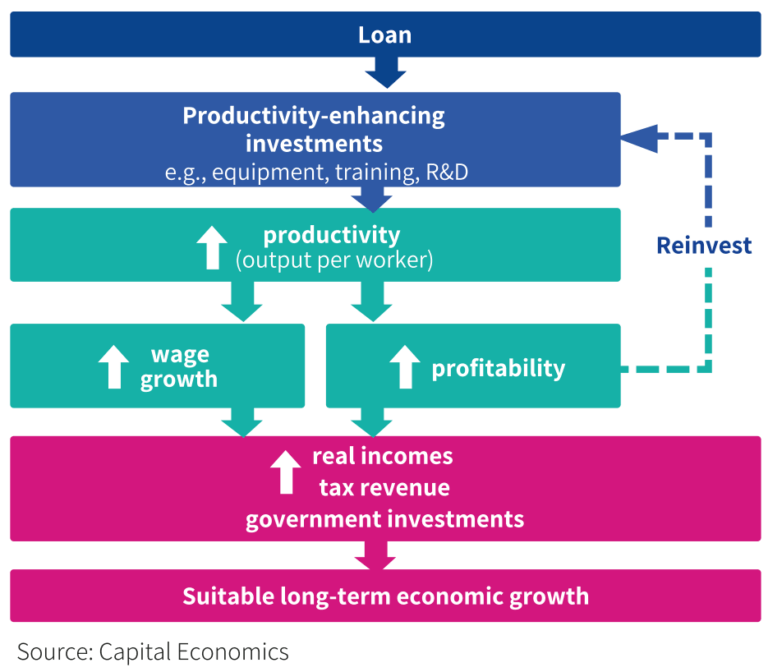
The pathway works as follows:
Loan → Investment
Businesses deploy capital into equipment, training, digital tools, staff, stock, R&D, or process upgrades.Investment → Productivity
Output per worker improves. Capacity expands. Firms complete contracts faster and bid for larger ones.Productivity → Higher Wages & Profitability
Financial headroom widens. Retained earnings grow.Higher Wages & Profits → Reinforcement Cycle
Businesses reinvest rather than stagnate.Reinvestment → Stronger National Output
This feeds into tax revenues, real income growth and, in theory, government investment.
This model explains why the 19% uplift is not a statistical anomaly.
Finance creates capacity. Capacity creates revenue.
Why One Third of UK SMEs Also Find Finance “Difficult to Access”
According to the Capital Economics data:
47% of SMEs say “access is difficult”
Yet, this sentiment does not correlate with actual lending capacity
Approval conditions today are less restrictive than post-2008 or post-Covid
So why the mismatch?
Because SMEs are applying through the wrong channels.
The data notes that SMEs default to:
Their main bank
Google searches
Personal recommendations from non-finance professionals
Generic online applications
Lenders whose products do not match the business model
This structural misdirection explains why access feels hard.
In reality:
The UK has 900+ active SME lenders
More than 9,000 finance products across these lenders
Specialist lenders covering almost every vertical (construction, retail, manufacturing, logistics, B2C services, e-commerce, medical, automotive, trade services)
Approval times now measured in hours, not weeks
But if SMEs don’t know which products exist, the ecosystem becomes invisible.
The UK’s Productivity Problem Is Fundamentally a Funding Awareness Problem
Key macro-economic insights from the 2025 SME impact report analysis include:
1. SME investment is correlated with national productivity
50%+ of UK output and employment depends on SMEs.
Underinvestment suppresses the national growth rate.
2. UK SME lending remains 14% below 2015 levels
This disconnects SMEs from capital precisely when they need it most.
3. SMEs want to invest, but don’t know where to start
SME sentiment data shows strong growth intent, but weak pathways to execute.
4. Finance awareness is the single biggest lever for national GDP
Raising SME financial literacy and directing businesses to suitable products would accelerate:
Output
Hiring
Regional growth
Innovation
Tax receipt generation
5. New lenders are outperforming big banks
Challenger and specialist lenders now account for the majority of SME lending activity.
This is what makes awareness critical.
The ecosystem has evolved, but SME behaviour has not.
The Real Cost of Not Knowing Your Finance Options
The opportunity cost for SMEs is substantial:
Missing the 19% uplift, or up to 42% if you’re in the construction industry
Reduced ability to take on contracts
Delayed hiring
Slower technology adoption
Lower productivity per worker
Less resilience in downturns
Fragmented cashflow
Inability to capture market share
Higher unit costs from underutilised capacity
When businesses self-exclude from finance: their competitors do not.
And this widens the productivity gap sector by sector.
How Finspire Helps Businesses Overcome the Awareness Barrier
This article’s purpose is not to say “finance is good”, it’s to clarify that, in the UK, knowing where to go is the real barrier when you are in the market to grow at an accelerated pace utilising external capital.
Finspire’s approach directly solves this by:
Mapping the business model against all available products
Identifying the correct structure, not just the obvious one
Avoiding mismatched applications (the #1 cause of declines)
Using specialist lenders who understand niche industries
Consulting on repayment logic, risk posture, and growth objective
Presenting the business in lender-ready format
Reducing time-to-decision to hours, not weeks
In short:
Finspire replaces uncertainty with understanding, and understanding with growth.
To finish things off...
The 2025 SME Impact Report confirms what many in the commercial finance ecosystem have long suspected:
SMEs who borrow grow faster
A 19% turnover uplift is now statistically validated
The UK’s biggest SME barrier is not credit risk or lender appetite
It is simple lack of awareness
And correcting this could materially shift UK productivity trends
Finance is not the final step of business growth, it is the starting point.
For UK SMEs, the question is no longer:
“Can I get finance?”
but rather:
“Do I know what options exist, and who can help me navigate them?”
Finspire exists to make the answer yes.