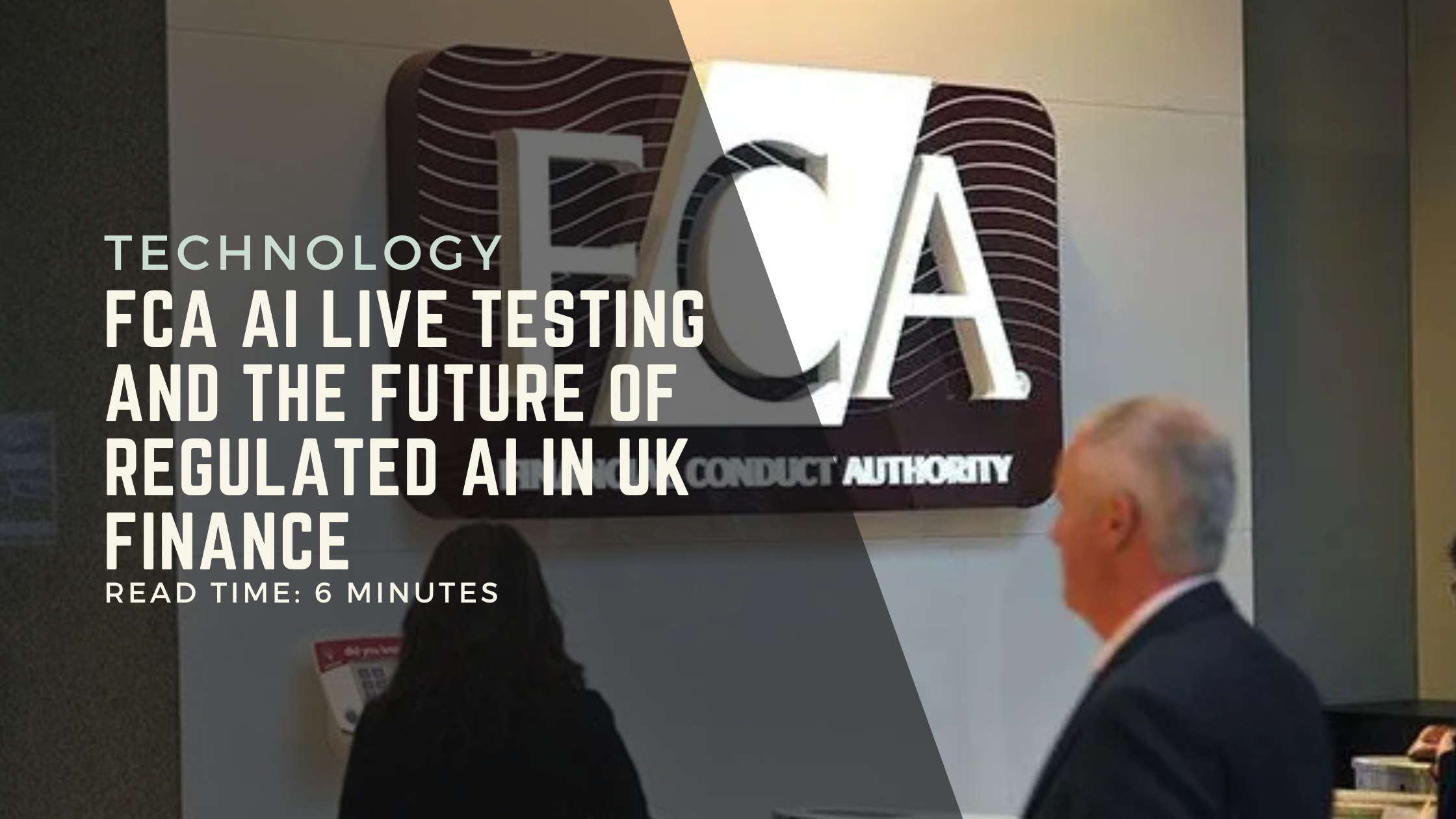
On 3 December 2025, the Financial Conduct Authority (FCA) introduced AI Live Testing, a framework allowing regulated firms to deploy artificial intelligence systems in controlled live environments under direct supervisory engagement.
This is more than a technical pilot. It reflects a fundamental shift in regulatory posture towards AI: a move from conceptual oversight and retrospective intervention to real-time, evidential, governance-based supervision.
The first cohort, including NatWest, Monzo, Santander, Scottish Widows, Avantia Group and Gain Credit, signals a cross-section of the UK’s financial ecosystem committed to advancing responsible AI. The FCA’s technical assurance partner, Advai, adds an uncommon depth of adversarial and robustness testing capacity that traditional supervisory teams do not possess.
The message is unmistakable:
AI is now considered central to the future of UK financial services. The regulatory priority is not to restrict it, but to ensure it can be deployed safely, defensibly and at scale.
What AI Live Testing Actually Is, and Why It Matters
AI Live Testing is not an extension of the sandbox. It is a supervised deployment mechanism for firms already prepared to introduce AI into operational workflows.
The FCA is using this initiative to scrutinise how models perform under conditions that no simulation can fully replicate.
The programme is designed to help firms:
Validate system behaviour in real-world environments
Evidence alignment with SYSC, PRIN, MAR and the Consumer Duty
Establish demonstrable governance and SMCR accountability
Test model robustness against drift, bias and adversarial manipulation
Measure explainability and auditability in production conditions
Build real-time monitoring and escalation pathways
But the deeper purpose is strategic.
The FCA is positioning itself to understand how AI interacts with markets, operations and consumer outcomes before system-level risks accumulate.
This is a shift from regulating deterministic systems to supervising probabilistic, adaptive models that evolve during use.
What the Cohort’s Use Cases Reveal About AI’s Trajectory
The inaugural cohort is concentrated on retail-facing applications, and that is not coincidental.
These are the domains where AI is already influencing consumer outcomes and where regulatory risk is most acute.
The cohort is testing:
AI-driven affordability modelling and debt-resolution pathways
Automated financial advice, guidance and behavioural nudging
NLP-based complaint triage and accelerated dispute handling
Intelligent customer engagement and conversational AI
Predictive analytics for saving and spending decisions
These use cases sit directly at the intersection of:
Consumer Duty
Discrimination and fairness obligations
Operational resilience (SYSC 19)
Data governance and explainability standards
Model risk management frameworks
Their selection shows the regulator’s priorities:
AI is acceptable in high-impact consumer journeys only if the governance environment is sophisticated enough to support it.
Governance, Accountability and Assurance: The Real Core of the Initiative
Although the announcement speaks positively about innovation, the underlying objective is governance assurance.
The FCA wants to observe whether firms can answer questions that have defined global debates around AI in finance:
What constitutes sufficient explainability for live ML-driven lending models?
When does model modification become “material”?
How should firms measure and maintain fairness across demographic cohorts?
What is an acceptable level of uncertainty or error in automated decisions?
How are model-risk functions structured, and where does SMCR accountability sit?
How is drift detected, escalated, and remediated?
What does “monitoring” actually mean in a production environment?
Advai’s involvement is significant, it signals that adversarial testing, fragility evaluation, and robustness assurance will become expected components of any AI system touching financial decisions.
This aligns with emerging global doctrine:
EU Artificial Intelligence Act
U.S. NIST AI Risk Management Framework
Basel Committee insights on AI in credit risk
Bank of England’s Model Risk Principles
The FCA is not seeking to build a new AI rulebook.
It is mapping how existing regulatory frameworks must evolve in the presence of AI.
Implications for Banks, Insurers, Lenders and Fintechs
For regulated firms, AI Live Testing formalises a standard: AI deployment is impossible without rigorous governance, documentation and accountability.
To meet supervisory expectations, firms will need to demonstrate:
End-to-end model inventories and lineage
Transparent data provenance
Fairness testing with measurable thresholds
Robust monitoring dashboards
Clear intervention protocols and human override structures
Audit trails for all automated decisions
Defined model-risk appetites
SMCR-mapped accountability for algorithmic outcomes
But this should not be framed only as a compliance burden.
Firms with credible governance will deploy AI earlier, faster and with greater confidence than those lacking foundation.
Governance is not the brake, it becomes the accelerator and the new gold standard of risk assessment.
The UK’s Strategy: Regulatory Agility Through Collaboration
The UK’s approach diverges significantly from other jurisdictions.
Where the EU has opted for prescriptive legislation and the U.S. for voluntary frameworks, the FCA is using pragmatic, supervisory engagement to shape expectations.
Key elements of the strategy:
1. No new AI-specific legislation
Current rules (SYSC, PRIN, MAR, Consumer Duty) are deemed sufficient if reinterpreted for AI.
2. Supervision through participation rather than post-event enforcement
The FCA wants empirical evidence, not hypothetical compliance.
3. Collaboration with technical specialists
Acknowledging that AI assurance requires deep expertise not embedded in traditional supervisory teams.
This positions the UK as a jurisdiction where responsible AI can scale without regulatory paralysis.
Opportunities and Risks Emerging From the Programme
Opportunities
Faster deployment of high-quality AI systems
Lower compliance ambiguity
Stronger evidence for Consumer Duty alignment
More consistent and fair customer outcomes
Reduced operational overhead
Improved fraud detection and risk modelling
Enhanced attractiveness of UK financial markets for AI-led entrants
Risks
Misunderstanding of explainability expectations
Overconfidence in unvalidated models
SMCR liability exposure for algorithm-induced harm
Unintended discrimination or exclusion
Adversarial vulnerabilities in production
Model fragility under stress or data drift
AI Live Testing exists precisely to surface these risks in a supervised environment before they can affect consumers or markets.
Preparing for the January 2026 Cohort
Firms planning to apply must be materially ready.
This is not a sandbox for experimentation, it is a supervisory exercise. There already exists a regulatory sandbox for experimentation, and has been available since 2021.
Applicants should have:
A near-production AI model
Documented governance structures
Training data and lineage documentation
Fairness and bias methodologies
Monitoring dashboards and alerting
Defined SMCR assignment
Evidence of Consumer Duty alignment
A clear remediation plan for model failure
Participation will likely become an industry badge of credibility, proof that a firm’s AI governance meets an emerging regulatory benchmark.
A Foundation for the Next Decade of Responsible AI in Finance
AI Live Testing marks a watershed moment for UK financial regulation.
It signals a recognition that AI will not remain peripheral, it will become embedded in every customer journey, payment flow, credit decision and risk assessment.
The FCA’s stance is clear:
AI adoption is expected.
Governance is non-negotiable.
Explainability and fairness must be substantiated, not asserted.
Supervision will happen in real time, not after the fact.
The firms that master AI governance will lead the market.
The UK is now positioning itself as a global leader in responsible, scalable and commercially viable financial AI.
Those who participate early will help shape the standards the rest of the world follows.