If you can’t pay your tax bill in full, HMRC’s Time to Pay (TTP) arrangement may let you spread the cost over monthly instalments. But its sole purpose is to ensure HMRC recovers your liability as quickly as possible, it is not designed to “improve your business cashflow” as some advisors and consultants may lead you to believe.
On the surface, it looks simple: if you meet the eligibility criteria, you can apply online through HMRC’s self-service tool, or call their dedicated helpline if not.
This guide explains how to apply step by step, the different criteria for Self Assessment, VAT, PAYE and Simple Assessments, and what HMRC will ask you for.
But before you apply, it’s worth understanding what you’re signing up for first: a TTP might solve a short-term cash crunch, but it will also signal to lenders that you are in arrears, which has lasting effects on your ability to access capital, despite not showing on your personal credit file. We’ll cover these risks in this article.
What a Time to Pay (TTP) arrangement is (and what it isn’t)
A TTP is an instalment plan HMRC offers to collect outstanding tax liabilities over time rather than in a single payment. It is practical and often necessary, but it is not a financing product and HMRC is not a lender. Entering a TTP means HMRC records the liability as tax arrears; underwriting teams and lenders treat that as a sign of financial stress even if it doesn’t appear on your personal credit file. For underwriting, arrears matter. They increase perceived risk and limit access to business credit, or at the very least – make it more expensive to borrow. (gov.uk)
HMRC is not a “creditor” in the normal sense
General accounting practices, and accountants describe HMRC as a “creditor,” but this is misleading. A creditor in the traditional sense is a supplier, lender, or investor that voluntarily extends you credit. HMRC is not in that category, it is His Majesty’s Revenue & Customs, the tax authority. Its role is to collect tax, not to lend or offer business services.
That difference matters:
Any interest or fees charged by HMRC on late tax is not deductible against profits like loan interest often is.
From an underwriting perspective, a TTP is not seen as “supplier credit,” it is recorded as tax arrears. Lenders treat arrears with HMRC as a serious sign of financial stress.
So while “HMRC as creditor” may work as an accounting label, in the real-world context, HMRC is the tax-man, not funding-solution.
Eligibility: When You Can Apply for a TTP Online
HMRC has expanded its online “self-serve” TTP tool, but eligibility rules are strict.
Self-Assessment taxpayers
Owe £30,000 or less.
Latest tax return filed.
Within 60 days of the deadline.
No other payment plans or debts with HMRC.
Able to pay within 12 months.
VAT taxpayers
Owe up to £50,000–£100,000 depending on scheme.
Debt from an accounting period starting 2023 or later.
All VAT returns filed.
No other HMRC debts.
Plan to clear within 12 months.
Not in Cash Accounting, Annual Accounting, or Payments on Account schemes.
Employers’ PAYE
Debt under £100,000, less than 5 years old.
All PAYE and CIS returns filed.
No other HMRC debts.
Repayable within 12 months.
Simple Assessment
Debt between £32 and £50,000.
No other HMRC debts.
If you don’t fit the criteria, you must call HMRC’s dedicated helpline (0800 200 3822) and provide full financial disclosure.
Step-by-step: how to apply for a Time to Pay (practical)
Step 1: Gather your paperwork
- Tax reference (UTR / VAT / PAYE reference)
-
Bank account details (Direct Debit authorisation)
-
Latest filed tax returns and company accounts
-
A clear income & expenditure breakdown (personal and business). If you have independent debt advice, a Standard Financial Statement is accepted (gov.uk)
Step 2: Try the online self-serve tool first (if eligible)
Sign in to your Personal Tax Account / Government Gateway and follow the online TTP pathway for Self Assessment, VAT, or PAYE. The system will ask for affordability details and propose repayment terms. Use the online option where possible, it’s quicker and limits mis-recorded phone notes.
Step 3: If you’re not eligible online, call HMRC
Have your paperwork ready. Expect detailed questions about income, outgoings, assets and why you cannot pay. HMRC will expect you to use savings or sell non-essential assets if you have them. If HMRC thinks you could pay sooner, they may refuse or shorten terms.
Step 4: Agree terms and set up Direct Debit
If HMRC accepts your proposal, they’ll set up the repayment schedule and take the agreed monthly Direct Debit. Make sure you can meet it; defaults can accelerate collection and you may be forced into liquidation.
Step 5: Keep accurate records
Save all email confirmations, letters and a copy of the agreed schedule. If cashflow later worsens, contact HMRC quickly, but be aware repeat requests attract scrutiny.
What HMRC will expect you to show
Real and provable inability to pay now. If your statements show spare cash or saleable assets, HMRC will expect them used first.
Evidence you genuinely need the time, not that you simply diverted working capital elsewhere. HMRC may treat that as “carelessness” or mismanagement. (“Carelessness” is a 30% surcharge above the HMRC interest rate)
That the plan is sustainable. HMRC runs affordability checks and expects full transparency. Repeatedly flagging cashflow troubles can lead HMRC to open compliance checks and result in an audit of your accounting history.
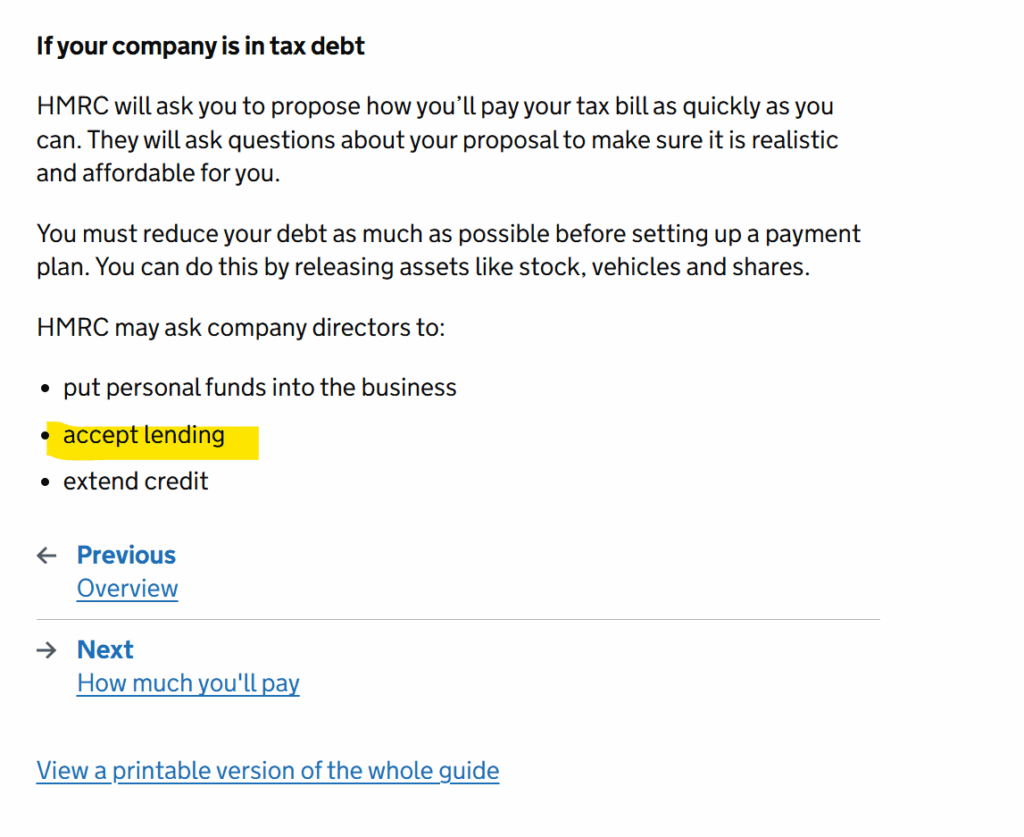
And critically, HMRC asks directors to inject personal funds and take out lending before granting a TTP (this is stated explicitly on GOV.UK guidance). In other words, HMRC would rather you borrow commercially and pay them on time than extend your arrears.
This is where tax loans become relevant: instead of being pushed into borrowing reactively under HMRC’s instruction, businesses can proactively explore structured tax funding loans. These clear your HMRC liability on time, preserve your credit standing with lenders, and unlike HMRC interest, the loan interest can often be deducted against profits.
Alternatives to TTP: Smarter Options for Businesses
Before defaulting on your HMRC liabilities, explore funding options that can preserve or better your credit profile and offer tax-deductible interest:
Short-term tax loans / HMRC funding: Pay HMRC in full, spread the cost with a lender, and often claim interest as a deductible business expense. See how HMRC funding can empower SME expansion.
Invoice finance / factoring: Release cash tied up in unpaid invoices.
Business overdraft or short-term facility: Quick access to working capital without signalling arrears.
Merchant cash advance: Useful if you process card payments.
Director or shareholder loan: If affordable, can be cheaper than HMRC interest.
These alternatives mean HMRC sees you as paid on time, and that makes all the difference when you next apply for credit and for avoiding needless HMRC scrutiny.
Why HMRC as “first port of call” can hurt your business credit
Underwriting perspective ≠ accounting perspective.
Accountants may view a TTP as a pragmatic cashflow tool, and often urge you to utilise this as a service. Lenders and underwriters view it as an auto-decline red flag, or best case scenario, results in a much more expensive loan.You’re admitting tax arrears.
When you ask HMRC for a TTP, you’re effectively saying you are in arrears. Repeatedly telling HMRC your cashflow is tight can trigger deeper scrutiny. HMRC will expect clear evidence you cannot pay: if your accounts show available cash or assets that could be realised, they’ll typically insist you use them.Interest and “carelessness” risk.
HMRC charges interest on unpaid tax. In some cases HMRC may also assess penalties if the cause is judged careless or negligent. This carelessness is applied at a surcharge rate of 30% above the 8.75% HMRC rate. Interest on HMRC arrears is not tax-deductible, whereas interest on a business loan structured for tax funding often is.HMRC is stricter and less reachable.
Phone support is reduced and HMRC is increasingly pushing self-service, meaning more cases are assessed through automated checks and affordability assessments. That makes it harder to negotiate flexible, sympathetic terms. Recent coverage shows HMRC scaling back helplines and focusing on online self-serve channels. (The Guardian)
Bottom line: a TTP is an emergency tool if you’re genuinely in financial distress with a failing or generally unhealthy business.
FAQs
No, but it does show up in your financial statements, and will be visible to lenders. They will still treat it as a default/arrears when assessing applications.
Yes. If you have personal savings, assets, or cashflow that could cover the debt, HMRC will expect you to pay.
No. Loan interest often is, which makes external funding more efficient.
Not always. In many cases, you need to log in yourself or grant explicit consent for an agent or accountant to act on your behalf. But in almost all cases, HMRC will want to speak with you directly.
Yes. HMRC guidance asks company directors to “accept lending” or inject personal funds before agreeing to a TTP. In practice, this means HMRC wants you to exhaust all other options before relying on them for extra time.
Only if your business is genuinely in distress and failing. A TTP is essentially a last-resort option when you have no other way to pay.
Be Strategic, Not Reactive
Time to Pay arrangements have their place, but they should be a last resort, not your first step. They signal arrears, damage your borrowing profile, and expose you to HMRC’s scrutiny.
For business owners looking to protect their creditworthiness and keep growth options open, a tax-funding loan or alternative finance facility is safer, cheaper, and more tax-efficient.
If you’re unsure which route to take, we provide free consultations to assess your cashflow and guide you through tax loan alternatives. We only get paid when we secure funding for you.