This week Barclays has cut more than 20 mortgage products. After a turbulent March and April, this is a sign that lenders are beginning to compete again, but borrowers should be careful about assuming that today’s pricing will still be available for long.
HSBC UK, Halifax, Santander and TSB have also reduced selected mortgage rates, Virgin Money has cut some five-year fixed rates, and HSBC has reduced a number of residential and buy-to-let mortgage products. The commercial message is not that borrowing has suddenly become cheap again, it is that lenders are repricing quickly in both directions, and borrowers with live plans should treat this as a practical window to review their options immediately.
For homeowners, landlords, property investors, developers and business owners looking at a purchase, remortgage, product transfer, capital raise, bridge exit or wider property refinance may now find terms that were not available during the worst of March’s volatility. But the same market forces that allowed lenders to cut rates can also push pricing back up quickly, especially considering current market conditions, hence why acting fast is crucial.
Why the latest mortgage rate cuts matter macroeconomically
The immediate reason these cuts matter is not because fixed mortgage rates have returned to low levels. They have not. Moneyfacts data cited in the market update showed the average two-year fixed-rate homeowner mortgage at around 5.87% this week, compared with 4.83% at the beginning of March. The average five-year fixed-rate homeowner mortgage was around 5.76%, compared with 4.95% just over a month earlier.
The meaningful point is that lenders have started reducing selected products after a sharp repricing period. That tells borrowers two things. First, lender appetite has not disappeared. Secondly, pricing is being adjusted actively, which means product availability cannot be treated as static.
A borrower who paused in March or April because rates moved too sharply should now consider rechecking affordability, loan-to-value, product choice and lender appetite. This is especially relevant where a refinance is already time-sensitive, such as a fixed-rate ending, a bridge approaching maturity, a landlord refinancing higher-rate debt, or an investor trying to secure a purchase before another buyer moves.
To clarify, this is not a call to borrow for the sake of it. It is a call to test the market where you may already have a commercial need.
This is not a calm rate-cutting environment
The current rate-cutting environment is very different from a normal easing cycle. Lenders are not simply reducing products because the economy is settled and rates are moving down in a predictable line. They are responding to swap-rate movements after a period of severe volatility.
Mortgage pricing volatility has been driven by the repricing of swap rates, which are a key benchmark for fixed-rate mortgage pricing. Swap rates reflect market expectations for future interest rates across terms such as two, five and ten years. When swap rates move up, lenders often increase fixed-rate pricing quickly because their own funding assumptions have changed. When swap rates settle, lenders may cut pricing to stay competitive, but they can reverse those cuts if the market changes again.
That is why the latest reductions need to be viewed as an executable window, not a guaranteed trend.
In March, Moneyfacts reported that the average mortgage deal lifespan fell to just eight days, the lowest since its records began in November 2011. Overall mortgage product choice shrank by 1,283 options and fell below 7,000 for the first time since November 2025, with lenders pulling products because of uncertainty over the future path of interest rates.
For borrowers, that means speed matters. A rate shown today may not still be available by the time documents are ready, affordability has been checked, or valuation has been instructed.
Why swap rates can change mortgage pricing before base rate moves
Many borrowers still assume fixed mortgage pricing is mainly driven by the Bank of England base rate. The base rate matters, especially for trackers, standard variable rates and wider market sentiment. But fixed-rate mortgage pricing is heavily influenced by swap rates.
A lender offering a two-year or five-year fixed mortgage is not only looking at today’s base rate. It is looking at the expected cost of money across the fixed period, the competitive position of other lenders, balance sheet appetite, risk margin, capital allocation and the likelihood that market conditions may move before the loan completes.
This is why mortgage products can be repriced even when the Bank of England has not changed the base rate. It is also why a borrower can see fixed rates rise sharply in anticipation of future inflation or future monetary tightening, then see selected cuts when swap rates stabilise.
The Bank of England’s current Bank Rate is 3.75%, with the next decision due on 30 April 2026. The Bank has also stated that the Middle East conflict has disrupted energy supply and pushed up energy prices, creating higher short-term inflation pressure.
That creates a complicated backdrop. A base rate cut would likely support borrower sentiment, but higher inflation makes the decision more difficult. Even if the base rate stays unchanged, the wording from the Bank of England can still affect swap pricing and lender behaviour.
Inflation is the risk sitting behind the mortgage window
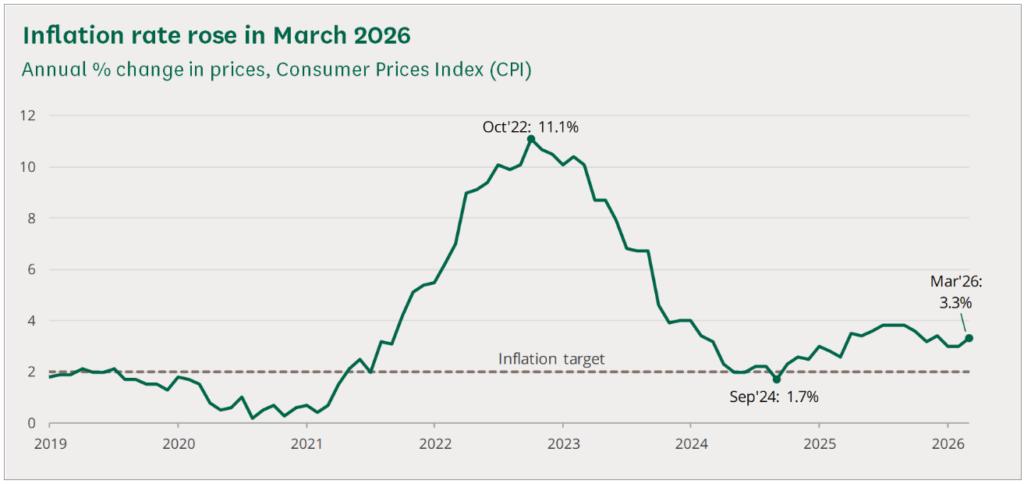
The reason this window may be short-lived is inflation. ONS data shows CPI inflation rose to 3.3% in March 2026, up from 3.0% in February. Core CPI eased slightly to 3.1%, down from 3.2%, but services inflation increased to 4.5%, up from 4.3%. Food and non-alcoholic beverage inflation also rose to 3.7%, up from 3.3%.
Services inflation matters because the Bank of England watches it closely as a sign of domestic cost pressure. Energy shocks can be volatile and external, but services inflation is often more persistent because it can reflect wages, rents, business costs and local pricing behaviour.
Before the Middle East conflict and associated energy price shock, the House of Commons Library noted that CPI had been expected to fall closer to 2% from April 2026 and remain around that level for the rest of the year. The Bank of England has since indicated that CPI is likely to be between 3% and 3.5% in the second and third quarters of 2026 because of higher energy prices.
For mortgage borrowers, this does not automatically mean rates rise. It means the risk environment is less stable. If inflation data worsens, swap rates could move up again. If swap rates move up, fixed mortgage products can be withdrawn or repriced quickly. If lender funding costs rise, lenders may protect margin rather than chase volume.
That is the commercial reason to review the market while lenders are cutting, rather than waiting passively for perfect conditions.
Economic confidence is also weakening
Mortgage pricing is not only about inflation. Lenders also care about borrower resilience, employment risk, property liquidity, rental coverage, affordability and exit strategy.
Ipsos’ Economic Optimism Index shows how fragile sentiment has become. Its latest data, collected between 8 and 14 April 2026, found that 78% of Britons expect the economy to worsen over the next 12 months, with net economic optimism at its lowest level since Ipsos began collecting the data in 1978.
The Resolution Foundation has also warned that higher energy prices linked to the Middle East conflict could leave the median working-age household £480 worse off this year, with typical household income growth moving from an expected gain into a projected decline.
For property finance, that matters because lenders do not price in a vacuum. If households are under pressure, lenders become more alert to affordability. If businesses face higher energy, transport and wage costs, business owners using commercial property, investment property or owner-occupied premises as part of their funding strategy may face more scrutiny. If unemployment risk rises, lenders become more cautious about income durability.
This is why a short-term reduction in rates should not be mistaken for a full return to easy credit conditions.
Why buy-to-let borrowers and landlords should pay attention
The rate movement is not limited to high-street residential mortgages. An alternative mortgage provider on our panel has reduced selected two-year and five-year fixed-rate buy-to-let products by 0.20%, effective from 22 April 2026, across 15 Core products for individual borrowers, limited company SPVs and LLPs. It has also increased the maximum loan size for standard products to £1.5m.
That is important because buy-to-let refinance has been under pressure for some time. Higher rates have affected interest coverage ratios, rental stress testing and refinance proceeds. Some landlords have found that a portfolio which worked at lower rates produces materially different borrowing capacity at today’s pricing.
This move does not mean every landlord will now qualify, and it should not be treated as the best or only option. It does show that specialist lenders are still adjusting appetite and pricing where they can see a commercially sensible opportunity.
For limited company SPV borrowers, portfolio landlords and larger buy-to-let investors, this may be useful where there is a need to refinance higher-rate debt, release capital, restructure borrowing, consolidate facilities, or secure a purchase. For this particular lender, the increase in maximum standard loan size to £1.5m may also help some larger buy-to-let transactions that sit above typical small-ticket landlord borrowing but below institutional debt.
To clarify, Finspire Finance can place mortgage packages north of £300m, so the information above is to demonstrate current market conditions by using a specific lender example.
Why property purchasers should not wait until the last minute
For buyers, the risk is not only the rate itself. It is the combination of rate, product availability, valuation timing, underwriting speed and chain pressure.
If a borrower waits until exchange is close before confirming finance, they may find that the product they expected has been withdrawn. If affordability is tight, a small rate movement can affect maximum borrowing. If the property is unusual, mixed-use, tenanted, high-value, newly converted, part-commercial, or owned through a company structure, the lender pool may already be narrower.
A buyer who obtains current terms early has more control. They can understand what deposit is required, whether the chosen lender is realistic, whether the property type fits criteria, and whether the application needs to go through a mainstream bank, specialist lender or alternative finance route.
If rates improve further before completion, the position can often be reviewed. But if rates move up again, the borrower who already has a packaged case and realistic lender route is in a stronger position than the borrower who waited.
Why remortgage and refinance borrowers should act earlier
For homeowners and landlords approaching the end of a fixed rate, timing is especially important. Waiting until the final few weeks can reduce choice. It can also force a borrower into a rushed decision if rates move suddenly, documents are missing, or affordability is tighter than expected.
The same applies to borrowers using property to raise capital for business purposes. Business owners often use property refinance to release equity, restructure expensive debt, support working capital, fund expansion, or replace short-term finance. In a volatile market, that needs to be planned properly because the lender will look beyond the property value. They may assess trading performance, business bank statements, tax position, personal credit, existing commitments and the purpose of funds.
For developers and investors, a refinance or bridge exit can be even more sensitive. A small change in rate, valuation, rental assumption or lender appetite can affect whether the exit fully clears the existing facility. Where a project has delays, cost overruns or leasing risk, the application needs to be positioned early and clearly.
Why speed and packaging matter when lenders are repricing
When lenders are repricing aggressively, clean packaging becomes more valuable. A strong application is not just about filling in a form. It is about giving the lender enough confidence to issue terms and move the case forward before the market changes.
For a residential refinance, that may mean income evidence, bank statements, credit explanations, mortgage statements and property details are ready early.
For a landlord or portfolio investor, it may mean a full portfolio schedule, rent roll, tenancy details, mortgage balances, company accounts, tax calculations, SPV structure, lease details and clear repayment strategy.
For commercial property, it may mean leases, tenant covenants, service charge position, asset management plan, valuation assumptions, trading accounts where relevant, and a realistic explanation of how the loan will be serviced.
For bridge exits and restructuring cases, it may mean a clear explanation of why the existing debt needs replacing, what has changed, what the exit route is, and why the proposed lender should be comfortable.
In a slower market, weak packaging can cause delays. In a volatile market, weak packaging can cause a borrower to miss the product entirely.
What borrowers should do now
Borrowers with live property plans should not treat these rate cuts as a reason to rush into unsuitable debt. The sensible approach is to use the current pricing movement to check the market while lenders are still competing. A practical review should cover:
- Current borrowing requirement
Confirm whether the need is purchase, remortgage, product transfer, capital raise, buy-to-let refinance, bridge exit, commercial refinance or debt restructure. - Affordability and coverage
Review income, rental coverage, business cash flow, loan-to-value and any stress testing that may affect lender appetite. - Product availability
Check which lenders are actually available for the borrower profile and property type, rather than assuming headline rates apply. - Timing risk
Identify whether the case is exposed to completion deadlines, rate expiry, bridge maturity, development delays or chain pressure. - Documentation
Prepare the submission before products are withdrawn or repriced. - Alternative lender routes
Where high-street lenders are too slow or criteria do not fit, consider specialist mortgage lenders, buy-to-let lenders, commercial investment lenders, bridging lenders or structured refinance options.
Mortgage availability depends on borrower circumstances, property type, affordability, credit profile, loan-to-value, rental coverage where relevant, and lender criteria. Pricing is not guaranteed, and no borrower should assume that a product shown today will remain available until they are ready to apply.
The practical opportunity
The current cuts from Barclays, HSBC, Halifax, Santander, TSB, Virgin Money and other alternative mortgage providers show that lender appetite is still present. That is the positive part of the story. The cautious part is that this appetite is operating in a market still shaped by inflation risk, energy shocks, weak confidence, swap-rate volatility and the next Bank of England decision.
For borrowers, the opportunity is not to predict the bottom of the market, it is to secure options while market conditions remain competitive.
If the numbers work now, there may be a case for moving. If the numbers do not work, one should at least understand the gap and can plan around deposit, equity, rental income, affordability, timing or whether the project one’s pursuing is even worth pursuing.
The take-away
If you are already considering a purchase, refinance, remortgage, buy-to-let refinance, bridge exit or property debt restructure, this is a sensible time to test the market rather than wait for perfect conditions. Current reductions may help, but the same market that has allowed lenders to cut rates can also move quickly in the opposite direction.
Speak to Finspire Finance
Finspire Finance can help borrowers, landlords, developers, property investors and business owners review their position, compare realistic mainstream, specialist and alternative property finance options, and package the case properly before pricing or product availability changes again.
Whatsapp usEmail us