Britain has entered a new phase of its clean-energy transition. After years of delays, NESO has reshaped the grid connection process, clearing out hundreds of speculative “zombie projects” and prioritising the ones that can genuinely be delivered. With 283 GW of ready-to-build generation, storage and demand-side capacity now fast-tracked, and more than £40 billion in annual investment unlocked, the UK finally has a defined pipeline capable of achieving Clean Power 2030.
But the significance of this shift goes far beyond energy policy. It reshapes the economic landscape, redirects private capital, and creates new commercial pathways for SMEs, particularly those supplying engineering, civils, environmental, manufacturing and digital services. For many regions, this is the beginning of a multi-year uplift in clean-energy activity.
Finspire Finance has already been financing this sector directly. We’ve delivered funding solutions for a 1.2 MWh battery storage installation for a renewable-energy project, structured project finance for a waste-to-energy facility, and deployed growth capital into biofuel and commercial solar ventures. That experience gives us a direct line of sight into the challenges and opportunities SMEs will face as this transition accelerates.
A Structural Reset of the Grid
The previous grid queue had become unmanageable, more than 700 GW of projects competing for limited capacity, many lacking planning permission, land rights or financing. NESO’s shift to a “first ready, first connected” model has cut through that backlog. Projects now have to prove they are genuinely deliverable before entering the priority pipeline.
This creates a clear, investable development sequence for the first time in over a decade. Developers, investors and supply chains now have visibility on where and when new projects will proceed, reducing risk and allowing earlier mobilisation.
Britain Was Stuck in Gridlock
The scale of the issue prior to reform is best shown visually.
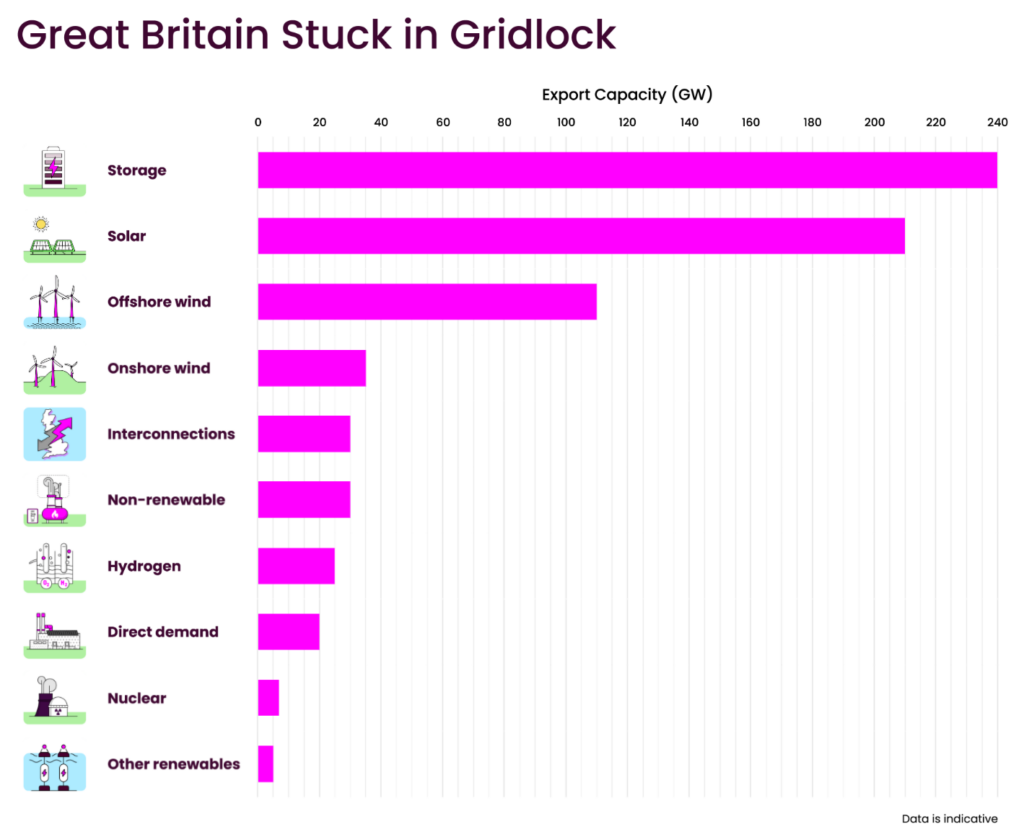
Storage projects were queued at nearly 250 GW, solar close to 180 GW, and offshore wind above 120 GW. Meanwhile, essential technologies, interconnectors, hydrogen, direct industrial demand and nuclear were overshadowed.
This imbalance meant even highly viable projects waited years behind schemes that were never likely to be built. NESO’s reform clears this bottleneck and directs grid capacity to projects aligned with national targets.
The Zonal Map: Where Britain Needs More Solar, Wind and Batteries
NESO’s zonal delivery map provides the first transparent view of where new capacity is needed, and where the system is already saturated.
Solar
Several regions are projected to fall short of solar capacity by 2035, while others exceed their future requirements. Rooftop installations are not counted in the dataset, meaning real deployment is higher, but the strategic message is clear: some zones urgently need more commercial and ground-mounted solar.
Onshore Wind
England and Wales face a significant onshore wind deficit by 2035, while Scotland exceeds its target. Future connection opportunities will therefore concentrate on ready-to-build projects in England and Wales.
Battery Storage
The queue for batteries is oversubscribed by a factor of three. All zones are effectively full until the next application cycle opens in 2026–27. However, protected projects will continue, with clustering initially in southern Scotland and later in North Wales, the Mersey and the Humber.
These insights are not abstract. They signal where engineering, manufacturing, environmental, logistics and electrical-contracting SMEs will see increased demand over the coming years.
A Financial Reality Check: Will the New System Quietly Push Smaller Developers Out?
While NESO’s reform solves a critical structural bottleneck, it introduces a less-discussed financial risk, one that disproportionately affects smaller developers and, by extension, the SMEs that support them.
Historically, small developers secured early queue positions long before they were fully ready. That position allowed them to bid for Contracts for Difference (CfDs) or negotiate power-purchase agreements. A guaranteed tariff, in turn, unlocked bank financing for construction. It was not a perfect system, but it enabled smaller, innovative firms to compete.
Under the new regime, a developer must be almost fully ready, planning secured, land rights in place, engineering progressed, financial alignment demonstrated, before they can even join the priority queue. For smaller firms without large balance sheets, this creates a circular barrier: they cannot reach the tariff stage without readiness, and they cannot achieve readiness without the tariff that unlocks financing.
In effect, market readiness risks becoming synonymous with capital strength. Large utilities and international developers can demonstrate readiness quickly; smaller players cannot. If left unaddressed, this dynamic could quietly consolidate the market, reduce competition in CfD auctions, and push up long-term energy costs.
For SMEs, the downstream effects matter. A concentrated developer landscape tends to contract procurement options, squeeze margins, and reduce flexibility in regional supply chains. A diverse development ecosystem, by contrast, spreads opportunity across projects of different scales, geographies and technology types.
NESO’s intent is sound. But policy and competition oversight must ensure that “first ready” does not become “first rich.” If, in the coming years, the UK sees fewer independent developers entering the market, reduced CfD competition or stalled community-scale projects, the root cause will not be in doubt, and many will rightly say that we saw this coming.
Where SMEs Can Gain
Despite this structural risk, the grid reset creates substantial near-term opportunity for SMEs, particularly in zones where accepted projects fall short of 2035 requirements.
Civils firms will see increased mobilisation as solar and wind projects accelerate. Electrical contractors with HV competencies will be in high demand, both for grid-connection works and for substation upgrades. Fabricators and modular manufacturers will benefit from predictable project sequencing. Environmental consultancies will see heightened demand as readiness criteria tighten. Transport, logistics and plant-hire firms will find longer, more dependable deployment cycles.
Britain’s clean-energy expansion is deeply SME-led. The companies that prepare early, through skills investment, compliance readiness and flexible financing, will be the ones that secure multi-year growth.
The Financing Gap: Preparing for Scale
Clean-energy deployment relies on capital-intensive mobilisation: equipment procurement, specialist labour, VAT exposure, engineering studies and elongated debtor cycles. Without the right financial structure, SMEs risk being unable to take on the very contracts the transition will generate.
Our experience securing funding for a 1.2 MWh battery system, waste-to-energy projects and multiple solar and biofuel ventures has shown us the same pattern across the sector: those who secure working-capital facilities, mobilisation funding, asset finance and VAT solutions early are the firms that scale fastest.
A strong financing framework is now not just advantageous, it is essential.
Conclusion
NESO’s overhaul is a long-overdue correction to a grid system stuck in procedural gridlock. It clears the path for realistic, region-aligned energy deployment and unlocks tens of billions in investment annually. But it also introduces competitive and financial dynamics that must be monitored carefully to protect smaller developers and the SME supply chains that power the UK’s energy transition.
For SMEs, this is a moment of opportunity, and a moment for strategic preparation. Those who align early with the zones that need capacity, invest in skills and equipment, and secure the right funding structures will be best positioned to grow alongside Britain’s clean-energy economy.
And if, in the coming years, policymakers question why small developers are disappearing from the pipeline or why CfD competition has thinned, we will be ready to say, we told you so.