At first glance, the latest UK labour market data looks constructive. Private sector wage growth has cooled to 3.6%, easing concerns at the Bank of England that domestic inflation pressures remain entrenched as it gives the impression that wage growth is outpacing inflation.
But this headline misses a more important, and more troubling reality for the UK economy: unemployment is rising at the same time as wage growth appears to hold up. That combination is not a sign of strength. It is a sign of structural friction.
Why Rising Earnings Don’t Mean the Labour Market Is Healthy
The first issue is how earnings are measured, and who is excluded.
When unemployment rises, those who lose their jobs simply fall out of the earnings data. Their absence does nothing to pull down average or median wage figures. Instead, it can perversely make wage growth look more resilient than the lived experience of the economy actually is.
Even median earnings, often cited as a cleaner measure, still mask distributional distortion. Large pay increases at the very top of the income scale, equity-heavy compensation, senior executives, partners, continue to skew perceptions of wage strength, even as conditions deteriorate for the majority.
This is why headline wage growth and rising unemployment can coexist without contradiction.
The Inflation Overlay: Where the Real Pressure Shows
Once earnings are viewed through the lens of inflation, the picture becomes clearer.
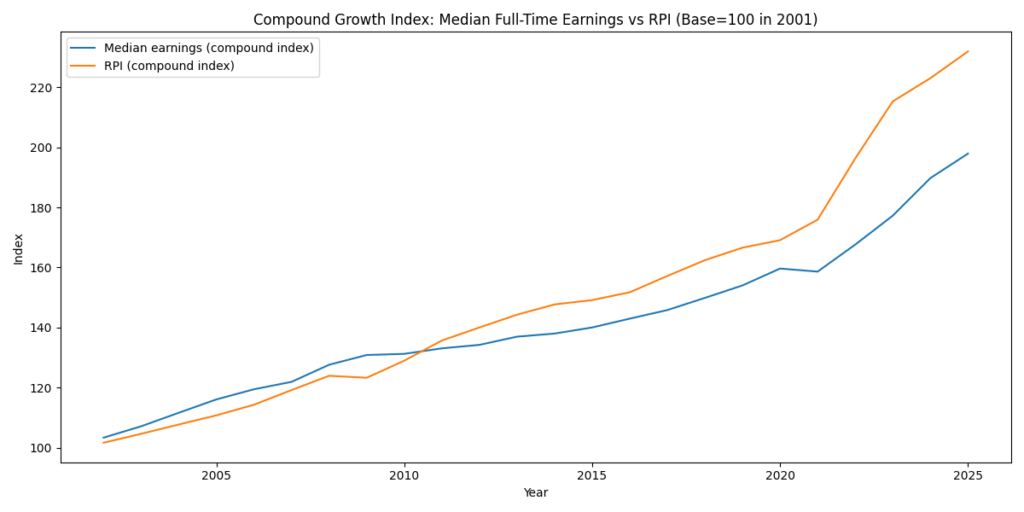
When median full-time earnings are compared against Retail Price Index (RPI) inflation, real purchasing power has steadily eroded over time. As the chart illustrates, earnings growth has failed to keep pace with living costs, particularly since 2021.
For households, this means wages feel weaker than the headlines suggest.
For businesses, especially small businesses, it means fragile demand, unpredictable cashflow, and limited pricing power.
This is not an environment that encourages confident hiring.
The Missing Explanation Behind Rising Unemployment
So why is unemployment continuing to climb?
Cost pressures are one part of the story, higher wages, higher national insurance, higher compliance costs. But they are not the full explanation.
The deeper issue is risk asymmetry.
Despite there being more small businesses in the UK than ever before, many are choosing not to hire. Not because they don’t want to grow, but because the downside risk of hiring has become disproportionate to their size and resilience.
Why Small Businesses Fear Hiring, and the Tribunal System
This fear is not theoretical.
Many small business owners report being taken to employment tribunal for dismissing staff who were simply not performing adequately. In large organisations, underperformance is managed through long, formalised processes: performance improvement plans, written warnings, HR oversight, and legal review stretching over months or even years.
That model works for employers like Amazon or Asda. It does not work for a business with very few employees, no HR team, and an owner who is simultaneously running sales, operations, finance, and payroll.
Small businesses make decisions based on days, weeks, or months of observed performance, not multi-year HR frameworks. They cannot deploy complex “manage-out” tactics involving milestones, internal appeals, and procedural choreography, not because they are unwilling, but because:
- the administrative burden is too large
- time simply does not exist
- and cashflow may already be under strain
Yet the legal framework largely does not account for this reality.
A System That Treats Unequals as Equals
Employment law applies broadly the same procedural expectations to:
- multinational employers with deep legal resources, and
- first-time employers taking on their second member of staff
Tribunals understandably focus on process, and is a valuable resource for unfairly dismissed employees. But for small businesses, the absence of formal warnings, structured improvement plans, or extended documentation is often not evidence of unfairness, it is evidence of scale and fragility.
The result is a chilling effect:
- the financial risk of defending a claim
- the time cost of proceedings
- and the personal stress for founders already worrying about survival
Even when a business ultimately prevails, the damage is often already done.
How This Feeds Directly Into Unemployment
This is where the loop closes.
Small businesses account for around 99% of the UK business population. They are, by far, the largest potential source of job creation in the economy. Yet they are not hiring at anything like their capacity.
Faced with rising costs, squeezed margins, and asymmetric risk, rational small business owners respond in predictable ways:
- delaying hiring until demand is overwhelming
- avoiding permanent roles in favour of contractors
- limiting growth ambitions
- or choosing not to expand at all
This behaviour does not appear in wage growth statistics. But it shows up clearly in rising unemployment, particularly among younger and entry-level workers who disproportionately rely on small local businesses for their first roles and early career progression.
If we want to address unemployment meaningfully, we have to accept an uncomfortable truth: employment growth will not come from large corporations. It will come from small businesses, but only if employing people becomes easier, safer, and more economically viable for them.
That means improving margins at the small local business level by:
- reducing tax friction and hidden costs
- lowering tariffs and non-wage levies
- and easing regulatory pressure around hiring and firing
Until we acknowledge that small businesses are earning less than ever, while large corporations are often earning more than ever, this imbalance will persist.
Unemployment is rising not because businesses don’t exist, but because the businesses that employ most people no longer feel safe to hire.
Pro-Worker and Pro-Small Business Are Not Opposites
This is not an argument for removing worker protections. It is an argument for proportionality.
A framework that recognises:
- business size
- employee count
- early-stage employment risk
- and financial resilience
would encourage small businesses to hire earlier and more often, not less. Flexibility at the small end of the market would expand opportunity, improve labour mobility, and ultimately support wage growth more effectively than rigid uniformity.
Right now, the system works best when an employee faces a corporate giant. It works worst when the employer is a small business trying to survive the next quarter.
The Bottom Line
Headline wage data suggests wages outpacing inflation. Rising unemployment, and compound data, tells a different story.
When distorted earnings metrics, eroded real wages, and inflexible employment rules collide, the result is a labour market where jobs are not being created, even though businesses exist and demand still flickers.
If policymakers want lower unemployment, particularly among younger workers, the answer is not just rate cuts or wage targets. It is giving small businesses the confidence to hire without risking their own survival.